It had been five days since I left this room or saw any semblance of the outside world, surviving solely on Pepsi and the putrid leftover food I kept underneath my bed. You know you have sunken to the company of the lowest dregs of society when your own brain—the fleshy ball of pulp tasked with ensuring your body survives at any cost—justifies to itself that the green, wretched spores growing on your leftovers must surely be edible. I was sick, there was no doubt to this. I felt I must have some kind of sinus infection that forced a blockage in my ear. Living within an inner-city apartment complex, I had grown accustomed to the sound of traffic and the general hustle and bustle of the outside world, but today was different. It was completely silent. The world had finally given up on me; not even the birds sang, for they knew how much I despised them. Perhaps it was fitting. My father was a great man, but since his untimely death last week, I had found my mind racing with a loop of questions: Why did I not join him for that beer when he so asked me to? Why, in my youth, did I sneer and spite him when he posed such simple requests to me? To an already troubled mind, these questions forced it to circle further down the drain.
I must leave this pit, I thought to myself, lifting my body from my feces-stained mattress and stretching my legs, feeling the blood rush back to their old friends. It was then that the full weight of the room’s atmosphere hit me.
The odor was thick, heavy, and dizzying. It bore the pungent stench of a maggot-ridden carcass left to liquefy in stifling heat. But beneath the rot, right at the back of my throat, was an unmistakable undertone of… lilac. It was a bizarre, sweet perfume stitched into the decay. I blinked against the dizziness, my clogged ears popping slightly. I could half-expect the smell of a carcass amidst the mold and waste. “No matter,” I muttered into the dark, forcing a cough. “We’re entering Spring, after all.”
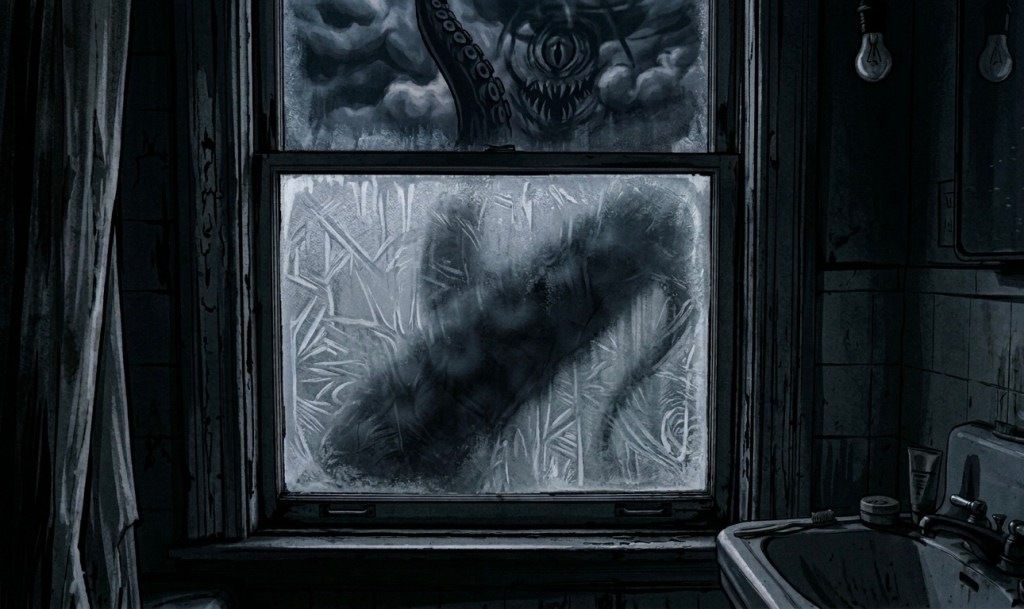
With exertion, I managed to walk to the door of my bedroom, flinging it open. It had been a while since the hinges had been put to use, so I flung the door wide. I walked into my bathroom and noticed my reflection in the mirror. A thought flashed through my mind: Disgusting. My natural skin color was white, almost ghostly, but five days within my room had left a layer of musk and grease upon my face. My face in the mirror was wrong. Deep, porous pockmarks cratered my skin, making my flesh look less like human tissue and more like a sponge waiting to absorb water. I twisted the valve on the tap and bent down to wash my face… or, I tried to wash my face—the water pressure was too weak, so I turned the valve some more. I could hear the rumbling of pipes below me, followed by a violent shudder. From the tap came a glob of pinkish, viscous liquid resembling the mucus from a snail. My nostrils tingled again; it was that comforting smell of lilac.
I stared at the pink glob as it clung to the porcelain basin, refusing to wash down the drain. I was exhausted; I could not even muster the energy to be repulsed by it. This fucking landlord, I thought. The plumbing hasn’t been updated in this building for years, even though there is surely a raw sewage buildup. My sinus infection must be playing tricks on me, that’s why I can smell lil— My rambling thoughts were cut short by the windowpane rattling. No, not rattling—the entire window frame was shaking violently. It seemed like there were dozens of heavy, wet hands slapping against the frosted glass. I didn’t look toward it; since I lived on the first floor of the apartment complex, my front door opened directly into the communal garden—I was accustomed to the sound of branches rattling against my window.
It was only when making my way into the kitchen I noticed how positively famished I was. Surviving on moldy leftovers does not, as I realized, make your body Herculean by any means. Beneath the musk and grease, my wretched limbs seemed to take on the appearance of brittle twigs. I could see the crevices of each individual vein as they worked to keep me alive.
I had a habit of keeping the black-out curtains closed in my kitchen, since it was directly next to my front door and looked out directly into the communal gardens. Although I knew what a disgusting, putrid thing I had become, I did not want others to have the same impression of me if they happened to glance inside my apartment. I still had some pride. The disadvantage of having black-out curtains constantly closed was that it cast the room into a deep, oppressive gloom. I went to open them and glanced out of the window, but even with the deterioration of my mind, I am sure of what I saw. Upon looking toward the sky, I noticed that there was, in fact, no sky at all. It had been replaced by a ceiling of writhing, undulating flesh. The thing, as I referred to it, did not even allow me to notice a horizon—it hovered over the Earth like a living canopy. Miles above the roofs of the apartment buildings, I could observe thousands of colossal, puckering tentacles descending and—this I am sure of—wrapping their wet suction cups around buildings, before pulling them at frightening speed up toward the thing’s mountain of flesh. This seemed to me like no creature at all; the thing was akin to a cosmic entity, or a planet, come face to face with our own.
I slowly backed away from the window, my once weak heart now thumping against my rib cage. My vision blurred, and I steadied myself against the kitchen counter. No, I thought. I have read about this kind of thing before. When one is starved of food and stagnant in his pit for so long, one has vivid, catatonic hallucinations. I rationalized it: It is a trick of the light, my mind is surely failing me. I need to get some food.
Reaching for the ajar kitchen cabinet, I peered inside. The now familiar smell of rot and lilac no longer fazed me, and I reached to see what was there. Pulling out a loaf of bread, I noticed something curious upon removing the plastic. The green mold that I was so accustomed to seemed to now take on a pinkish hue, and sprout tiny, translucent tendrils that pulsed ever so slightly, weeping liquid onto the bread. Throwing the bread into the bin, I thought to myself furiously: This is the last time I buy the cheap brands. The humidity in this city ruins absolutely everything. I’ll go to the shop nearby and find something.
I turned on my heel and walked toward the front door. My limbs felt heavy, hollowed out by days of starvation, but the thought of a fresh meal pushed me forward. As my hand reached for the lock, I felt the apartment building groan—it didn’t seem to be the sound of old wood, but a metallic, throbbing scream. It felt like something had settled directly onto the roof of my complex. I am truly losing my mind, I told myself as I removed the deadbolt. The fresh air will do me good. I twisted the handle, pulled the front door open, and stepped out into the world.
 My Rambling
Leave a comment